
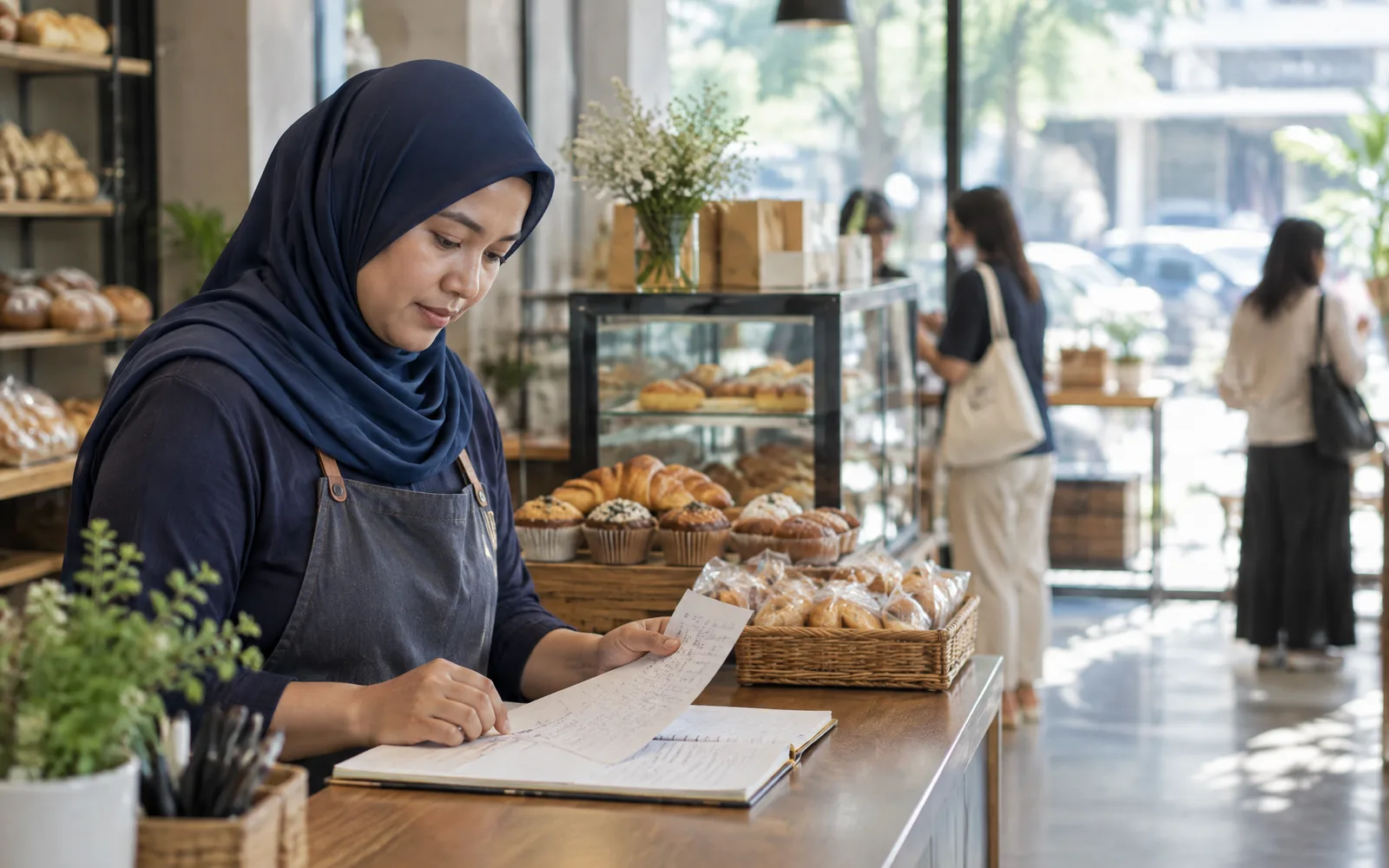
Ask ten Malaysian SME owners who their customer is and most will say “anyone who needs what we sell”. It feels safe, but it quietly makes every ringgit of marketing work harder, because a message aimed at everyone lands with no one. This guide sets out a practical way to narrow down to the customers most likely to buy, pay on time and come back, and then shows where those customers actually spend their time, online and offline.
Why “everyone” is an expensive answer
A bakery in Kota Damansara, a car workshop in Shah Alam, a tuition centre in Cheras and an online fashion seller in Johor Bahru all face the same problem. If the bakery posts about birthday cakes, office catering, wedding favours and Raya cookies in the same week, no single group feels the post was written for them.
An ideal customer is the group that gives you the most profit for the least effort, and that you can reach without burning cash. You will still serve others, but this is the one you design your offer, prices and marketing around.
Start with the customers you already have
Your own records already hold most of the answer.
- Pull the last twelve months of sales. Use your POS export, invoices, marketplace seller centre or WhatsApp order history.
- Sort customers by total spend, then by how many times they bought.
- Look at the top 20 per cent and ask: where are they, what did they buy, how did they find us, and what did they ask before buying?
- Do the same for the customers who complained, paid late or never returned. Those patterns tell you who to avoid.
Take the Shah Alam workshop as an illustration. Out of 300 customers in a year, 60 produced more than half of the revenue. Most were either small logistics firms running three to ten vans, or families with Japanese cars between five and ten years old. Neither group had ever been named in the workshop’s advertising.
Segment in plain terms
For an SME, three questions are enough to segment.
- Who are they? Age, location and life stage for consumers; industry, size and decision maker for businesses.
- What job do they need done? Not the product, but the outcome. A parent is not buying tuition; they are buying a better SPM result and less nagging at home.
- How do they buy? Where they search, who they ask, how long they take, and how sensitive they are to price.
Here is how the Cheras tuition centre might set out its segments.
| Segment | What they want | How they buy |
|---|---|---|
| Parents of SPM students | Results, discipline, progress updates | Referrals from other parents, WhatsApp enquiry, a visit to the centre |
| Parents of primary pupils | Safe, convenient, affordable | Facebook community groups, Google search for “tuition near me” |
| Working adults learning Mandarin | Flexible evening slots | Instagram, TikTok, direct message |
Three rows is plenty. If you have more than four segments, you probably have not decided yet.
A one-page customer profile worksheet
Write one profile per main segment, give the person a name, and answer each question in a sentence.
- Who is this person or business? For example, “Puan Aida, 36, works in Petaling Jaya, two children in primary school.”
- Where do they live, work or operate?
- What problem or event triggers the purchase?
- What worries them before they buy?
- How do they search, and whom do they ask for advice?
- Which other options do they compare you with?
- What are they willing to pay, and how do they prefer to pay?
- What would make them come back or recommend you?
- Which two channels can you reach them on most cheaply?
Pin the sheet near the counter or in your team’s WhatsApp group. Every new promotion should pass one test: would Puan Aida stop scrolling for this?
Where Malaysian SMEs actually find customers
Once you know who you are looking for, the data on Malaysian habits points to a few places.
The MCMC Internet Users Survey 2022 found that 97.7 per cent of internet users had a WhatsApp account, 87.5 per cent had a Facebook account, 63.9 per cent had Instagram and 49.7 per cent had TikTok. In the same survey, 66.6 per cent said they shopped or booked online, up from 45.0 per cent in 2020.
Younger buyers lean differently. A Merdeka Center survey of 1,605 Malaysians aged 18 to 30, carried out in April and May 2024, found Instagram was the favourite platform at 31 per cent, with TikTok and Facebook tied at 25 per cent. WhatsApp was still the messaging app for 94 per cent of them.
For buying, marketplaces dominate. An Ipsos Malaysia survey of 1,031 adults in May 2026 found that among people who had bought online in the past six months, 71 per cent used Shopee and 62 per cent used TikTok Shop, while Facebook stood at 15 per cent and Lazada at 11 per cent. Online grocery purchases rose to 47 per cent from 34 per cent a year earlier.
Almost everyone is on it, so it is where sales get closed and questions answered. It is a poor place to find strangers: your shop counter, not your signboard.
Facebook and Instagram
Facebook still has the broadest account ownership of any social network in the MCMC data, and its community groups are where neighbourhood services such as workshops, cleaners and tuition centres get discovered. Instagram suits anything visual and skews younger.
TikTok and TikTok Shop
Short video rewards personality and demonstration. A baker showing a cake being cut, or a mechanic explaining a common fault, can reach people who would never search for them. TikTok Shop turns that attention straight into orders.
Shopee and Lazada
Buyers here arrive ready to purchase and compare on price, ratings and delivery speed. Shopee is well ahead of Lazada in the Ipsos data. The Department of Statistics Malaysia recorded RM937.5 billion of e-commerce revenue in the first nine months of 2025, so the volume is real, but so is the competition.
Google Business Profile
Google says creating a Business Profile is free. It is the first thing many people see when they search for a service near them, and it gives you insights on calls, reviews and bookings. For any business with a location or a service area, this is the highest-return hour you will spend this month.
Referrals
Still the cheapest channel, and the one most owners leave to chance. Ask happy customers at the moment they are happiest, make it easy to forward your WhatsApp catalogue, and thank the person who referred.
Worked example: an online fashion seller
Suppose a modest-wear seller in Johor Bahru spends RM3,000 a month on advertising and gets about 200 orders. Her records show two groups.
Segment A is students aged 18 to 24 who arrive from TikTok. Average order RM80, returns 12 per cent, and 10 per cent buy again within three months.
Segment B is working women aged 28 to 40 who arrive from Instagram and her WhatsApp broadcast list. Average order RM160, returns 3 per cent, and 35 per cent buy again within three months.
If RM1,500 goes to each group and each produces 100 orders, Segment A yields RM8,000 in sales before returns and about RM7,040 after. Segment B yields RM16,000 before returns and about RM15,520 after. Over the following quarter, Segment B’s repeat buyers add roughly 35 orders worth RM5,600 at no extra advertising cost, against about RM800 from Segment A.
The numbers are for illustration, and the conclusion holds whenever one segment spends more, returns less and comes back more often. Segment B is the ideal customer. Segment A still matters, but it earns a smaller share of the budget and a different message.
Common mistakes
- Choosing the segment you find exciting rather than the one that pays.
- Copying a competitor’s audience without checking your own sales records.
- Describing a customer by age and gender only, with nothing about their problem or buying habits.
- Opening an account on every new platform instead of mastering two.
- Never revisiting the profile. Review it every six months or after a major change in what you sell.
Where to start
- Export twelve months of sales this week and rank customers by spend and frequency.
- Write one profile sheet for the top segment and pin it where the team can see it.
- Complete your Google Business Profile and WhatsApp Business catalogue before spending on advertising.
- Choose the two channels where that segment already is, and ignore the rest for now.
How Gusto Style can help
Our Sales & Marketing Plan is a fixed-price engagement for SMEs. We go through your actual sales records with you, build the customer profiles, choose the two or three channels worth your money and set out a 90-day plan with clear targets. You leave with a plan your team can run without us. See the Sales & Marketing Plan
Sources
- Internet Users Survey 2022, Malaysian Communications and Multimedia Commission, 2022
- Survey reveals Instagram as most popular platform among Malaysian youth, Malay Mail, 2024
- TikTok Shop closes in on Shopee as usage rises to 62pc among Malaysian online shoppers, Ipsos survey finds, Malay Mail, 2026
- Digital Malaysia: ICT and e-commerce now a quarter of the economy; revenue hits RM937.5b in nine months of 2025, Malay Mail, 2025
- Get Listed on Google - Google Business Profile, Google, 2026