How to Build a Practical Marketing Budget for Your SME
Two ways to set a marketing budget, a channel mix that suits a few thousand ringgit a month, what RM2,000 and RM5,000 plans realistically buy, and a five-column sheet to track results.

Business Insights
Practical guidance, business perspectives and educational resources on the issues that matter to Malaysian entrepreneurs and SME owners, from financial management and operational efficiency to business strategy and sustainable growth.

Two ways to set a marketing budget, a channel mix that suits a few thousand ringgit a month, what RM2,000 and RM5,000 plans realistically buy, and a five-column sheet to track results.

How to make a small business survive a shock: a cash buffer counted in weeks, limits on customer and supplier concentration, key-person cover and a two-page continuity plan.

A seven-step method for turning a growth idea into a plan that can be run: assess the business, set measurable targets, choose opportunities, prepare operations and watch the cash.

Cost-plus, value-based and tiered pricing explained with worked ringgit examples, plus how SST registration and marketplace fees change the lowest price you can afford to charge.

The model, not the product, decides how money arrives and how much you keep. Six models common among Malaysian SMEs, five questions to test them, and a worked three-way comparison.

The avoidable errors that close Malaysian start-ups early: mixed finances, default legal structures, hidden staff costs, missed filings and no monthly review, with a short illustrative case.

Six ways a small Malaysian business can compete with chains and marketplaces without a price war, a three-question test for any advantage, and a worked example from a Cheras bakery.

A step-by-step SWOT method for Malaysian SMEs: the five facts to gather first, how to fill each box with evidence, a worked Puchong retailer example and how to turn the boxes into three actions.

A one-week method for writing an SOP that staff will actually follow, a full worked outline for closing a kopitiam, and the habits that keep SOPs current without a quality department.

A weighted eight-question scoring method for judging a new venture, a Puchong café example with ringgit figures, and the red flags that should stop you whatever the score.

A practical way for Malaysian SMEs to profile their most profitable customers from their own sales records, and to find more of them on WhatsApp, social media, marketplaces and Google.

A step-by-step method for building a 12-month operating budget, including revenue by month, employer EPF, SOCSO and EIS on-costs, SST set-asides and a worked agency example.

The three sections of a cash flow statement explained, the direct and indirect methods, a three-month ringgit example, and four steps to build one from your own bank statements.

A short, bottom-up business plan you use every month beats a thick one written for the bank. Learn the eight sections that matter, with a worked three-year projection for a Malaysian company.

Map your process, measure waiting time and find the one step that caps your output. Includes a worked car workshop example and fixes that need no new software.

Repeat customers cost less than new ones. Learn how to measure your repeat rate, run a basic loyalty scheme, follow up on WhatsApp and recover complaints, with a worked RM example for a bakery.
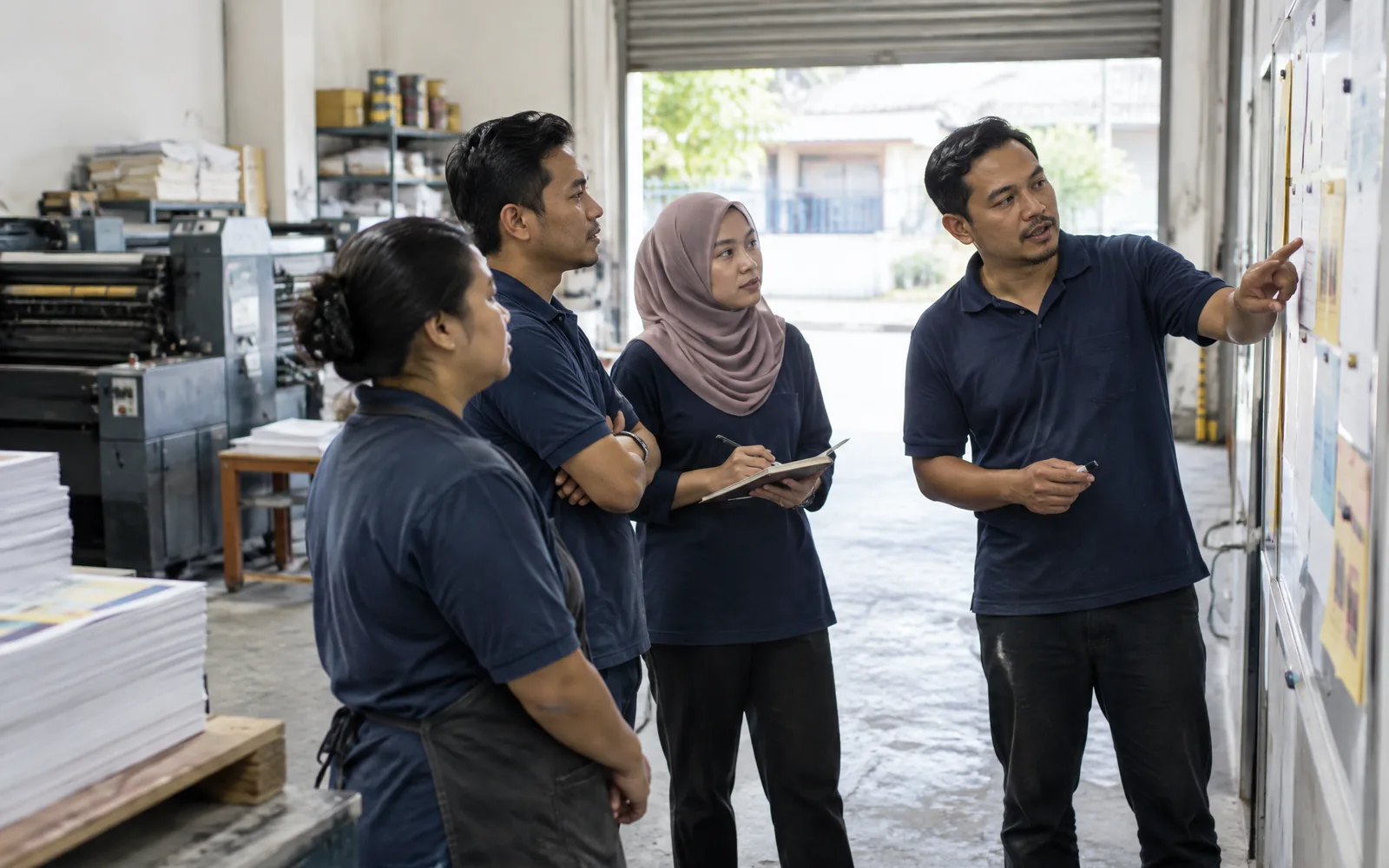
Learn how a small Malaysian team gets more done: find where the hours go, give every job an owner, keep a weekly rhythm and stay within the Employment Act's limits on working hours.

Learn stock turns, days of stock, reorder points and ABC analysis with a worked RM example for a café and a hardware shop, plus the counting routines and basic tools that keep stock accurate.

Learn a five-step routine for better business decisions: frame the question, create real options, sort by reversibility, run a 30-minute pre-mortem and know when to bring in outside eyes.

How to build a one-page risk register, control the six risk families that hurt Malaysian SMEs most (cash, compliance, people, operations, cyber and fraud), and choose the right business insurance cover.

Wages, rent, electricity, fuel, SST and supplier prices have all moved in 2025 and 2026. This guide shows Malaysian SMEs how to measure each increase, negotiate the biggest cost lines and reprice over 90 days.

Likes are not sales. Learn the four marketing numbers an SME should track, and how to collect them with a lead sheet, UTM links, Google Business Profile and Meta Ads Manager.

How Malaysian SME owners can choose five to seven KPIs that change decisions, where each number should come from, and what a Petaling Jaya service firm gained from measuring the right ones.

Sales on paper do not pay salaries. This guide explains why Malaysian SMEs run short of cash, how to build a 13-week cash flow forecast, and how to collect faster and time SST and statutory payments.

A map of SME financing in Malaysia as at October 2026: bank loans, SME Bank, Bank Negara funds, SJPP guarantees, TEKUN, MARA, ECF and P2P platforms, and what lenders check before they approve.

Compare a sole proprietorship with a private limited company (Sdn Bhd) on SSM fees, personal liability, yearly compliance and tax, with a worked RM300,000 example and a decision table.

Learn who must register for SST in Malaysia, the 6% and 8% service tax rates and the RM500,000 and RM1.5 million thresholds. Covers the 1 July 2025 expansion and the bi-monthly SST-02 filing cycle.

Seven practical steps for Malaysian founders before spending real money: validate demand, pick the right SSM structure, cost it properly and clear your licences.

Startup costs buy the business and working capital keeps it alive until customers pay. Learn how to list both, cost each hire at its true figure and size your cash buffer.

Gross, operating and net margin answer three different questions. Learn what each one tells you, with a worked Malaysian cafe example and the mistakes to avoid.

Five readiness signals tell you whether a second outlet, new product line, hire or new market will pay. Includes Malaysian staffing and licensing thresholds and two worked examples from F&B and online retail.

LHDN's RM3 million e-Invoice exemption, the exceptions that still catch small businesses, what the relaxation period allows until the end of 2027, and an eight-step checklist to get ready.

Profit on paper does not pay this month's salaries. Seven early signs that cash is tightening, a practical fix for each, and a 15-minute weekly check that keeps problems visible.

What a standard operating procedure is, the signs your business needs one, which three processes to document first, and a five-step method for writing SOPs that staff will follow.

The five things every bank checks before lending, what a bank-ready business plan contains, how to make financial projections believable, and the common reasons applications are rejected.

A ten-question yes-or-no check across sales, costs, cash, team and systems, with a scoring table and guidance on which gaps to address first.